Brazil vs. USA Real Estate: The Hidden Differences That Destroy Profits
 Natalia Ribeiro
Key Takeaways
- Brazilian investors approaching the US market with assumptions built in Brazil can see their net profit swing by 30% or more in either direction due to fundamentally different tax structures, transaction costs, and appreciation dynamics.
- US property taxes on vacant land are as low as $50–$200 per year, versus annual IPTU of 0.5–1.5% on Brazilian properties — making US land dramatically cheaper to hold over a 5–10 year investment horizon.
- Transaction costs in Brazil can reach 8–10% of property value (ITBI, cartório, agent commissions), versus 1–3% for US vacant land purchases, significantly affecting the breakeven threshold and total returns.
- The BRL/USD exchange rate has structurally depreciated from R$2.30 in 2014 to R$5.30 today — Brazilian investors holding dollar-denominated assets have a built-in return multiplier that compounds on top of property appreciation.
- The LOTSS$ Investment Comparator at lotsss.com/comparador allows investors to model these differences with their own numbers, providing a side-by-side comparison of Brazil vs. US returns for any investment amount and holding period.
Two Markets, One Costly Mistake
Every year, thousands of Brazilian investors look at U.S. real estate and see opportunity. They're right — but many of them approach the American market with assumptions built in Brazil, and those assumptions quietly destroy their returns.
The differences between investing in real estate in Brazil versus the United States go far deeper than currency and language. We're talking about fundamentally different tax structures, property rights, transaction costs, financing models, and appreciation dynamics that can swing your net profit by 30% or more in either direction.
We built the LOTSS$ Investment Comparator specifically to show these differences in hard numbers. But before you use the tool, let's break down exactly what most investors miss — and why it matters so much.
Property Taxes: The Cost Nobody Calculates Correctly
In Brazil, property tax (IPTU) is relatively straightforward — typically 0.5% to 1.5% of the property's assessed value annually. Most investors simply budget for it and move on.
In the United States, property taxes vary dramatically by state and county:
- Florida: Average effective rate of 0.86% — but no state income tax
- Texas: Average effective rate of 1.74% — also no state income tax
- Mississippi: Average effective rate of 0.63% — one of the lowest in the nation
- New Jersey: Average effective rate of 2.23% — the highest in the country
Here's what Brazilian investors miss: the absence of state income tax in Florida and Texas effectively offsets higher property taxes. In Brazil, you're paying IPTU plus income tax on rental gains (up to 27.5%) plus capital gains tax on the sale (15-22.5%). In Florida, your property tax is often your only recurring government cost on a land investment.
On a US$100,000 investment held for 5 years, the total tax burden difference between Brazil and a tax-friendly U.S. state like Florida can exceed US$15,000 — that's 15% of your entire investment eaten by taxes you didn't plan for.
The Vacant Land Tax Advantage
This difference becomes even more dramatic with vacant land. In the U.S., raw land parcels often carry annual taxes of just US$50 to US$300. In Brazil, even empty lots in growing areas face IPTU rates that assume future development value — sometimes US$500 to US$2,000 annually for comparable parcels.
Transaction Costs: Buying and Selling
This is where the comparison gets painful for anyone used to Brazilian real estate.
Buying in Brazil
Purchasing property in Brazil involves a cascade of fees:
- ITBI (transfer tax): 2-3% of the property value
- Registry fees (cartório): 1-2% of the value
- Real estate agent commission: 5-6% (typically paid by seller, but priced into the deal)
- Legal and documentation fees: 1-2%
Total transaction cost to acquire: 9-13% of the property value. That means on a R$500,000 property, you're spending R$45,000 to R$65,000 before you even own it.
Buying in the USA
U.S. transactions — especially land — are significantly cheaper:
- Title search and insurance: US$500-US$2,000
- Recording fees: US$50-US$250
- Closing costs: 1-3% on financed purchases (often near zero on cash land deals)
- Agent commission: Typically 5-6% on homes, but many land transactions have zero commission
Total transaction cost for a cash land purchase: often under 2%. On a US$10,000 parcel, you might pay US$150 total in closing costs.
Currency Dynamics: The Double Engine of Returns
This is the factor that sophisticated investors understand and beginners completely overlook.
When a Brazilian invests in U.S. real estate, two things can generate returns simultaneously:
- Property appreciation: The land or property increases in dollar value
- Currency appreciation: The dollar strengthens against the real
Over the past decade, the U.S. dollar has appreciated significantly against the Brazilian real. An investor who bought US$50,000 in U.S. land in 2016 at R$3.50/USD and sold that same land in 2026 — even with zero property appreciation — would see their investment worth approximately R$300,000 instead of the original R$175,000, purely from currency movement.
Brazilian investors in U.S. real estate have historically earned 8-12% annually just from the dollar-real exchange rate — on top of any property appreciation. This "double engine" effect is invisible on paper but transformative in practice.
Inflation Protection
Brazil's inflation has averaged 5-8% annually in recent years. The U.S. has averaged 2-4%. Holding assets denominated in dollars provides a natural hedge that Brazilian real estate simply cannot offer. Your purchasing power is preserved in the world's reserve currency.
Legal Framework and Ownership Rights
Many Brazilian investors are surprised to learn that foreigners can own U.S. real estate with the same rights as American citizens. There are no restrictions on land ownership, no special permits required, and no limitations on how many properties you can acquire.
Brazil: Complex Ownership Landscape
In Brazil, property ownership involves:
- Mandatory notarized registration at the cartório
- Risk of adverse possession (usucapião) if property is left unoccupied
- Complex inheritance laws that can lock assets in probate for years
- Restrictions on foreign ownership of rural land
USA: Clear and Protected Ownership
In the United States:
- Title insurance guarantees your ownership against all claims
- No adverse possession risk on properly recorded deeds
- LLC structuring provides asset protection and simplified inheritance
- Digital transactions — you can buy, hold, and sell land without visiting the property
The clarity of U.S. property rights is a major advantage that many international investors underestimate until they experience a problem in their home market.
The Real Profitability Comparison
Let's put it all together with a concrete example. Imagine two investors — each with US$50,000 — one investing in Brazilian real estate, the other in U.S. vacant land.
Scenario A: Brazil (R$300,000 apartment in São Paulo)
- Purchase costs (ITBI, cartório, fees): ~R$33,000 (11%)
- Annual IPTU: ~R$3,600
- Rental income: ~R$1,500/month (6% gross yield)
- Income tax on rent: ~R$4,050/year (27.5% bracket)
- Maintenance and condo fees: ~R$6,000/year
- Net annual return after costs: ~R$4,350 (1.45%)
- Appreciation (historical São Paulo): ~3-5% nominal, often below inflation
Scenario B: USA (5 vacant land parcels at US$10,000 each in growth corridors)
- Purchase costs: ~US$750 total (1.5%)
- Annual property taxes: ~US$750 total (US$150 per parcel)
- No maintenance, no tenants, no management
- Appreciation in emerging growth areas: 10-25% annually
- Currency hedge: additional 8-12% in BRL terms
- Net position after 5 years (conservative 12% annual growth): ~US$88,000
The difference isn't marginal — it's transformational.
See It with Your Own Numbers: LOTSS$ Investment Comparator
The data above reflects market averages. But your situation is unique — your investment amount, your timeline, your tax reality. That's why we built a free tool that runs this comparison with your real numbers.
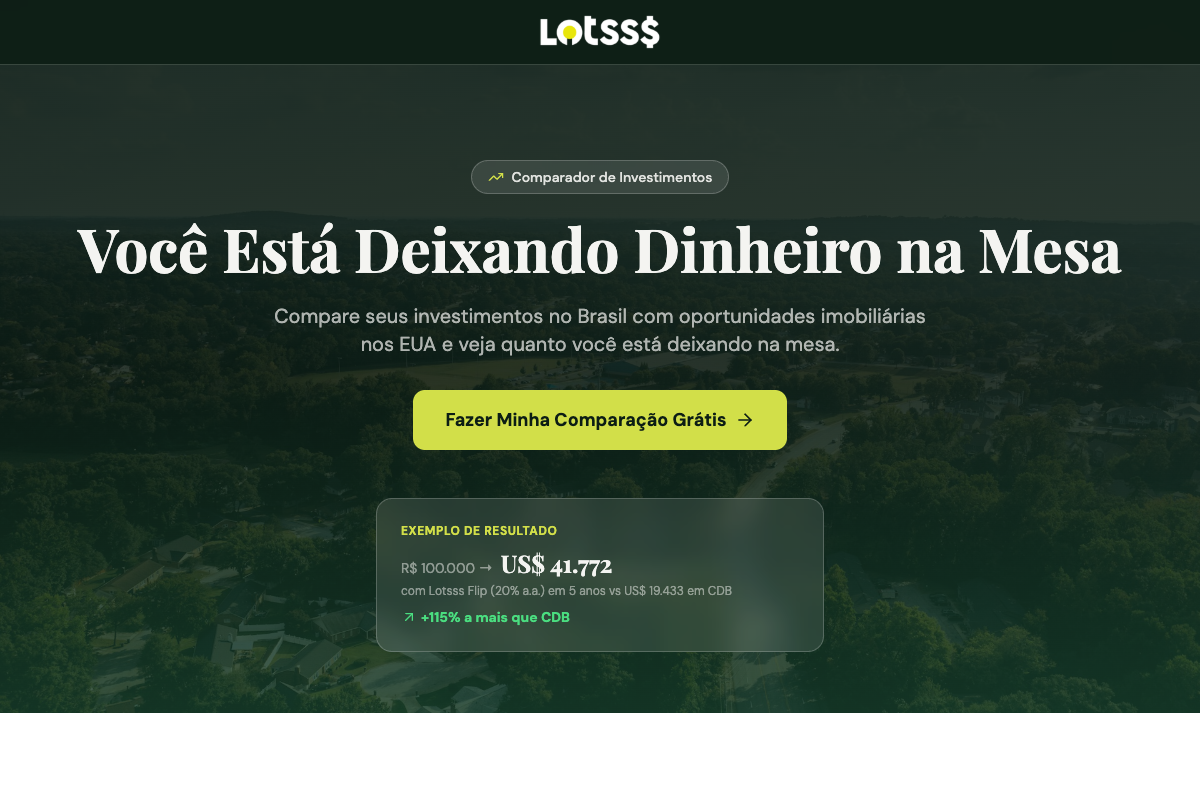
The LOTSS$ Investment Comparator is free, fast, and requires no signup. In under 30 seconds, you'll see:
- How your money would perform in U.S. land vs. Brazilian fixed income or real estate
- The real currency impact on your returns over time
- The net difference in reais — no surprises, no fine print
Free • No signup • Results in 30 seconds
Find out how much you're leaving on the table
Frequently Asked Questions
What are the main differences between real estate investing in Brazil vs. the United States?
The core differences affecting net returns are: (1) property taxes — US vacant land runs $50–$200/year vs. 0.5–1.5% annually in Brazil, (2) transaction costs — Brazil's ITBI, cartório fees, and agent commissions total 8–10% vs. 1–3% for US land, (3) currency dynamics — the BRL has structurally depreciated 130%+ against the USD since 2014, adding a return multiplier to dollar-denominated assets, and (4) legal protections — US property rights are among the strongest globally, with clear title transfer and enforceable contracts.
How do property taxes compare between Brazil and the United States for real estate investors?
In Brazil, IPTU typically runs 0.5–1.5% of assessed property value annually. On a R$150,000 property, that's R$750–R$2,250 per year. For US vacant land, Mississippi property taxes on a $10,000 lot average $50–$150 per year. Florida vacant land is similarly low. This difference in carrying cost compounds dramatically over a 5–7 year holding period, giving US land investors a structural cost advantage that directly improves net returns.
Why do transaction costs matter so much for Brazilian real estate investors?
Transaction costs determine your breakeven threshold — how much your property must appreciate before you profit. In Brazil, buying and selling a property can cost 8–10% of value in combined fees (ITBI, cartório, agent commissions). This means your property must appreciate 8–10% just to break even. US vacant land transactions typically cost 1–3%, meaning you're profitable after a fraction of that appreciation. Over multiple investment cycles, this difference compounds into significantly higher net returns.
How does the BRL/USD exchange rate affect Brazilian investors in US real estate?
The BRL has depreciated from approximately R$2.30/USD in 2014 to R$5.30/USD today — a 130%+ devaluation. For a Brazilian holding a US dollar-denominated asset, this means their investment has appreciated 130% in Real terms from currency alone, before any property appreciation. This isn't a one-time event — it's a structural pattern tied to Brazil's higher inflation, interest rate differential, and fiscal dynamics that has repeated across multiple economic cycles.
How can I compare Brazil vs. US real estate returns with my own numbers?
LOTSS$ built the Investment Comparator at lotsss.com/comparador specifically for this purpose. Enter your investment amount, holding period, and expected appreciation rates for each market, and the tool calculates side-by-side net returns including property taxes, transaction costs, currency effects, and total return in both BRL and USD. It's the only tool designed specifically to show Brazilian investors the full picture of US land investment versus domestic real estate.
Stop Guessing, Start Comparing
The differences we've outlined aren't theoretical — they're the exact dynamics that determine whether your international real estate investment builds wealth or quietly bleeds money.
The investors who profit from U.S. real estate aren't the ones who got lucky — they're the ones who understood the structural advantages before they wrote their first check. Now you have the same information they do. The question is what you'll do with it.
About Natalia Ribeiro
Managing Partner at LOTSS$, transforming accessible land into great investment opportunities in the USA.
Vacant Land vs. Rental Properties: Which Investment Wins in 2026?
Seller Financing for Land: How to Buy a Lot with $1,500 Down
Related Articles

Mississippi Tax Deed Auction Guide: Everything You Need to Know Before You Bid
A complete guide to bidding at Mississippi tax deed auctions — how they work, what to research, what pitfalls to avoid, and how to find the best opportunities in the state.

How to Buy Land Remotely: A Step-by-Step Guide for International Investors
You don't need to fly to the United States to buy land there. Here's a complete guide on how international investors can safely purchase US land without leaving home.
US Tax Advantages of Owning Land: What Brazilian Investors Need to Know
From FIRPTA rules to 1031 exchanges and depreciation strategies — a practical guide to US tax advantages for Brazilian investors who own land in the United States.